How to Train and Enable Marketing Teams for AI Adoption
Article Highlights
Key Takeaways
- 7 in 10 marketers say their employer does not yet provide generative AI training (Salesforce). A structured enablement program is the gap between AI investment and actual AI adoption.
- Effective AI enablement for marketing is a five-phase process: baseline assessment, proficiency benchmarking, role-based training, workflow redesign, and continuous learning culture.
- Skill gaps across marketing functions are uneven. A one-size-fits-all AI training approach fails both the power user and the skeptic.
- The most common mistake in AI rollouts: focusing on tools before people. Training without workflow redesign produces low adoption and wasted investment.
- Teams that build AI fluency now compound that advantage over time. Marketing AI adoption is a present-tense competitive issue, not a future consideration.
The Marketing Team That Didn’t Know It Was Already Behind
Somewhere right now, a competitor’s marketing team is using AI to write, test, and publish a month’s worth of content in a week. Their counterpart at a rival brand is using AI-powered analytics to predict which campaigns will underperform before they launch. And a third team is personalizing email sequences at a scale that would have required a headcount of 20, just two years ago.
Some marketing teams have been building AI workflows for two years. They’re not piloting anymore. They’re compounding. Every week they don’t stop, the gap widens. So the actual question isn’t whether to start. It’s how far behind you’re willing to fall before you do.
Every AI adoption article will hand you a tool list. That’s not the problem. The problem is what happens after you hand that list to your team and nobody uses it, because nobody redesigned the workflows, nobody addressed the anxiety, and nobody made time for the actual learning. Training and enabling a marketing team for AI adoption requires a deliberate strategy, one that addresses skill gaps, fear of replacement, workflow disruption, and change fatigue all at once.
This guide gives you that strategy, step by step. Whether you’re building an AI training program from scratch or trying to accelerate a stalled rollout, the framework below applies directly to marketing operations teams looking to move from pilot to production.
What Is AI Enablement for Marketing Teams?
AI enablement for marketing teams is the structured process of equipping marketers with the knowledge, tools, workflows, and confidence to integrate artificial intelligence into their day-to-day work, effectively and sustainably.
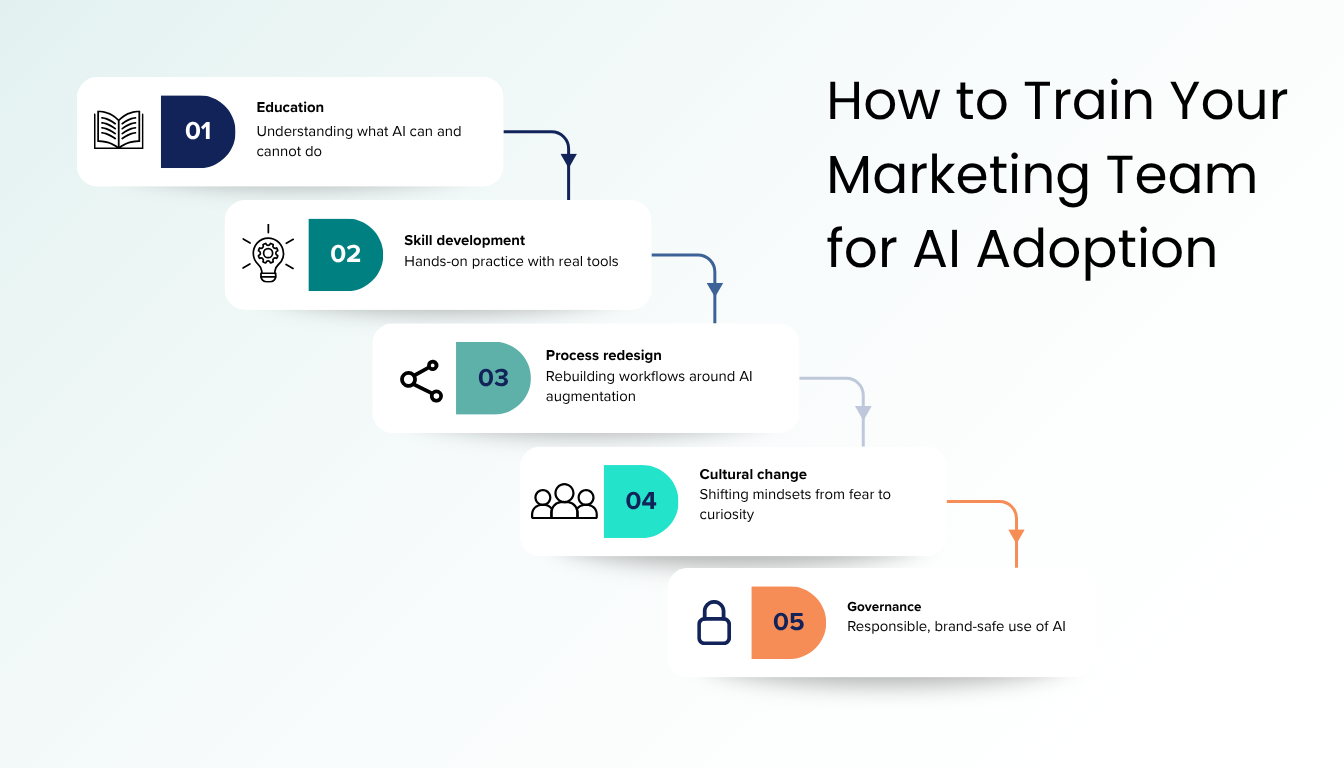
It goes beyond a one-time training session. True AI enablement combines five elements:
- Education: Understanding what AI can and cannot do
- Skill development: Hands-on practice with real tools
- Process redesign: Rebuilding workflows around AI augmentation
- Cultural change: Shifting mindsets from fear to curiosity
- Governance: Responsible, brand-safe use of AI
Without all five, AI adoption stalls. Tools get purchased, sit unused, and become a line item on a budget review instead of a competitive advantage.
Why Marketing Teams Struggle With AI Adoption
Before diving into how to enable your team, it helps to understand why most teams fail at AI adoption:
1. Fear of Replacement
According to Salesforce research on marketing and AI, one in four team leads worry AI will replace their job, and 7 in 10 marketers say their employer has not yet provided generative AI training. If team members believe AI is a threat to their jobs, they will resist it, consciously or not.
2. Skill Gaps Are Uneven
In any marketing team, you’ll find a wide spectrum: the one person who’s already built custom Claude workflows on their own time, and the senior content strategist who has never opened Claude. A one-size-fits-all training approach fails both.
3. No Clear Use Cases
When AI training is too abstract (“AI will transform everything!”), it doesn’t stick. Teams need to see exactly how AI applies to their specific role, their briefs, their channels, their KPIs.
4. Tool Overload
The martech landscape now includes hundreds of AI-powered tools. When teams aren’t given clear direction on which tools to use, they either choose poorly or don’t choose at all.
5. No Time Built In to Learn
Marketing teams are almost always understaffed and over-deadline. If learning AI is added on top of an already full workload, it doesn’t happen.
The 5-Phase Framework for AI Enablement in Marketing
Phase 1: Assess Your Baseline
Before you train anyone, you need to understand where your team actually stands. Skip this step and you’ll design training for the wrong audience.
What to assess:
- AI literacy levels: Can team members explain what a large language model does? Do they know the difference between generative AI and predictive AI?
- Current tool usage: Are people already using AI tools informally? Which ones?
- Role-by-role use case mapping: Where does each function (content, demand gen, social, analytics, brand) spend the most time on repetitive or scalable tasks?
- Attitudes and concerns: Run an anonymous survey. Surface the fears early.
Recommended outputs:
- An AI literacy heatmap across your team
- A use case inventory by role
- A list of tools already in use (sanctioned or not)
Pro tip: Identify your “AI champions” early, the 1 to 3 people on your team who are already enthusiastic and self-taught. They will become your internal trainers and social proof.
Phase 2: Define What “Good” Looks Like
Enablement without goals is just activity. Before training begins, define what AI adoption success looks like for your team, specifically.
Set role-specific AI proficiency benchmarks. For example:
| Role | Baseline Proficiency | Advanced Proficiency |
|---|---|---|
| Content Writer | Can use AI to draft and edit copy | Can build and manage prompt libraries; trains AI on brand voice |
| Paid Media Manager | Can use AI for ad copy variations | Can use AI for bidding recommendations and audience modeling |
| Marketing Analyst | Can use AI to summarize reports | Can use AI for predictive modeling and anomaly detection |
| Brand Strategist | Can use AI for competitor research | Can use AI for trend synthesis and positioning analysis |
Define business outcomes, not just skill metrics:
- Reduce time-to-publish for blog content by 40%
- Increase email A/B test volume by 3x per quarter
- Cut time spent on monthly performance reporting by 50%
Tying AI enablement to measurable business outcomes is how you secure leadership buy-in and budget.
Phase 3: Build a Structured, Role-Based Training Program
This is where most organizations under-invest. A single “intro to AI” lunch-and-learn won’t change behavior. You need a layered curriculum.
Layer 1: AI Foundations (All Staff)
Every marketer, regardless of role or seniority, should understand:
- How generative AI works (at a conceptual level)
- What AI is good at versus where it fails
- Your company’s AI use policy and data governance rules
- Prompt engineering basics
- How to critically evaluate AI-generated outputs
Format: Self-paced modules, 60 to 90 minutes total. Use platforms like Coursera or LinkedIn Learning, or build internal content.
Layer 2: Role-Specific Skills (By Function)
Move from general to specific. Content teams learn AI-assisted writing workflows. Analytics teams learn AI-powered reporting tools. Demand gen teams learn AI for campaign planning and optimization.
Format: Live workshops (2 to 3 hours) with hands-on exercises using real team workflows and actual tools your organization has licensed.
Key principle: Use your team’s actual work as training material. Have writers draft a real upcoming blog post with AI assistance during the training session. Have analysts summarize a real campaign report using an AI tool. Real-world application drives retention.
Layer 3: Advanced Mastery (Power Users and Champions)
For your AI champions and technically inclined team members, invest in deeper skills:
- Building custom GPTs or AI agents for marketing workflows
- Fine-tuning prompts for brand voice consistency
- Integrating AI tools into existing martech stacks via API
- AI ethics and bias in marketing applications
Format: Peer learning cohorts, external courses, or vendor-led deep dives.
If you’re looking for a structured approach to AI adoption that extends beyond the marketing function, the GTM AI enablement framework covers how to operationalize AI across the full go-to-market motion.
Phase 4: Redesign Workflows Around AI
Training teaches skills. Workflow redesign is what actually changes behavior.
After training, work with each function to map their existing workflows and identify where AI augmentation fits:
Content Workflow Example:
- Before: Briefing, manual research, draft, edit, review, publish
- After: Briefing with AI research, AI-assisted draft, human edit for voice and accuracy, review, publish
Key workflow redesign principles:
- AI handles the first draft; humans handle judgment. Never publish unreviewed AI output. Build human review into every AI-augmented workflow.
- Standardize your prompt library. Create a shared, team-accessible prompt library organized by use case (brief writing, headlines, social captions, email subject lines, etc.). This accelerates adoption and ensures consistency.
- Build AI tasks into job descriptions and OKRs. If using AI isn’t reflected in how success is measured, it stays optional.
- Reduce friction. The AI tools your team uses should be integrated directly into their existing tools, inside Notion, Slack, Google Docs, HubSpot, or wherever they already work. Every extra step reduces adoption.
Phase 5: Build a Culture of Continuous AI Learning
AI capabilities are evolving faster than any training program can keep up with. The goal isn’t to train once. It’s to build a team that learns continuously.
Tactics for sustained AI adoption:
- Monthly AI office hours: A standing 30-minute session where anyone can share what they’ve been experimenting with or ask questions.
- AI wins channel: A low-barrier Slack or Teams space for sharing prompts that worked, time saved, and outputs worth celebrating. Celebration drives adoption.
- Quarterly tool audits: Revisit which AI tools are being used, which aren’t, and whether new tools warrant exploration.
- Learning time protection: Block 2 to 4 hours per month per person for AI experimentation. Make it non-negotiable.
- External community access: Encourage team members to follow AI marketing communities and newsletters (like the Marketing AI Institute) and attend relevant events.
How to Manage Change Resistance During AI Adoption
Resistance to AI adoption is normal and should be expected. Here’s how to address it constructively:
Acknowledge the Fear Directly
Don’t pretend concerns about job security don’t exist. Address them head-on in your first team conversation: “AI will change how we work. It won’t eliminate the need for skilled marketers, but it will change what those skills are. Our job is to make sure you’re building the new ones.”
Lead With Augmentation, Not Automation
Frame every AI use case as “AI plus human” rather than “AI instead of human.” Emphasize that AI handles the time-consuming, repetitive work so that marketers can spend more time on strategy, creativity, and judgment. This mirrors how AI is reshaping revenue operations more broadly: the goal is leverage, not replacement.
Involve the Team in Tool Selection
Don’t hand down tools from leadership. Invite team members to evaluate options, run pilots, and give feedback. When people have a voice in the tools they use, adoption is meaningfully higher.
Celebrate Experimentation, Not Just Results
In the early phases of adoption, effort should be rewarded. Praise someone who tried a new AI workflow and it didn’t quite work. Normalize the learning curve.
Share Success Stories Relentlessly
Find the early wins, the campaign that went out faster, the report that took half the time, the A/B test that performed better, and tell that story to the whole team. Nothing drives adoption like visible proof.
Building an AI Governance Framework for Marketing
Enablement without governance creates risk. As you roll out AI adoption, establish clear rules of the road.
What to Include in a Marketing AI Policy
- Approved tools list: Which AI tools are sanctioned for use, and for what purposes.
- Data handling rules: What data can and cannot be input into AI tools (especially third-party tools). Customer PII, proprietary strategy, and confidential financials should generally stay out of public AI platforms.
- Brand voice standards: All AI-generated content must be reviewed against brand guidelines before publication.
- Disclosure guidelines: Where and when AI use must be disclosed (varies by channel and regulation).
- Accuracy verification: AI-generated facts, statistics, and citations must always be independently verified.
- Escalation process: Who to contact when AI produces something problematic.
Keep the policy clear, concise, and easy to access. A 30-page governance document no one reads is worse than a one-page guide that becomes second nature.
Key AI Tools for Marketing Teams by Function
| Function | Use Cases | Example Tools |
|---|---|---|
| Content and Copywriting | Drafting, editing, SEO optimization | ChatGPT, Claude, Jasper, Surfer SEO |
| Social Media | Caption writing, scheduling, trend analysis | Lately, Sprout Social AI, Hootsuite Insights |
| Email Marketing | Subject lines, personalization, segmentation | Klaviyo AI, HubSpot AI, Seventh Sense |
| Paid Media | Ad copy, audience targeting, bidding | Google Performance Max, Meta Advantage+, Pencil |
| SEO and Content Strategy | Keyword research, content briefs, SERP analysis | Semrush AI, Clearscope, MarketMuse |
| Analytics and Reporting | Data summarization, anomaly detection, forecasting | Tableau Pulse, Google Analytics Intelligence, Amplitude |
| Design and Creative | Image generation, creative concepting | Adobe Firefly, Canva AI, Midjourney |
Frequently Asked Questions About AI Adoption for Marketing Teams
How long does it take to train a marketing team on AI?
Most marketing teams see meaningful behavior change within 60 to 90 days when training is structured, hands-on, and supported by workflow changes. Basic AI literacy can be established in a single 90-minute session. Deeper role-specific proficiency takes 4 to 8 weeks of regular practice.
Should every marketer learn to use AI?
Yes, but not at the same depth. Every marketer benefits from AI literacy and foundational prompt skills. Role-specific applications should be tailored to each function. Advanced technical skills (API integrations, building AI agents) can be reserved for a smaller group of power users.
What is the biggest mistake companies make when rolling out AI to marketing teams?
Focusing on the tools before the people. Purchasing AI software and announcing it to the team without a structured enablement plan, governance framework, or workflow redesign leads to low adoption and wasted investment.
How do you measure the ROI of AI enablement in marketing?
Track both efficiency metrics (time saved per task, content output volume, campaign launch speed) and quality metrics (engagement rates, conversion rates, A/B test win rates). Compare pre- and post-adoption baselines. Most teams see measurable efficiency gains within the first quarter.
How do you handle team members who refuse to adopt AI?
Lead with empathy and education first. Understand the specific concern: is it fear, distrust, or confusion? Most resistance softens when people have positive hands-on experiences in a low-stakes environment. Sustained refusal to engage with required tools may eventually become a performance conversation, but that should be a last resort.
Can small marketing teams benefit from AI adoption as much as large ones?
Often more so. Small teams with limited headcount benefit enormously from AI’s ability to multiply output. A two-person content team using AI effectively can produce what previously required five people.
What is a marketing AI training program?
A marketing AI training program is a structured curriculum that teaches marketing team members how to use AI tools in their specific roles. It typically includes AI literacy foundations, role-based skill development (content, paid media, analytics, etc.), prompt engineering practice, governance guidelines, and workflow redesign to embed AI into day-to-day processes.
The Competitive Imperative
Here is the uncomfortable truth: AI adoption is not a future consideration. It is a present-tense competitive issue.
Teams that build AI fluency now will compound that advantage over time. The marketer who has spent a year prompt engineering, building AI workflows, and learning where AI adds value versus where human judgment is irreplaceable will be dramatically more productive, and more valuable, than the one who waited.
The role of marketing leadership is to create the conditions where that learning happens systematically, not accidentally. That means investing in training, protecting time for experimentation, building governance guardrails, and modeling AI adoption from the top.
The teams that get this right won’t just be faster or cheaper. They’ll be more creative, more data-driven, and more responsive to market shifts than competitors who are still running the same playbook they used in 2022. For a broader view of how these same dynamics are reshaping revenue functions, see how AI is changing the way teams design revenue processes from the ground up.
If you want expert support structuring an AI enablement program for your marketing team, connect with an InTandem expert who has done this across B2B marketing and revenue teams.
Action Checklist: AI Enablement for Marketing Teams
- Conduct an AI literacy and tool usage assessment across your team
- Map AI use cases by role and function
- Identify and empower your internal AI champions
- Define role-specific AI proficiency benchmarks
- Build a layered training curriculum (foundations, role-specific, advanced)
- Create a shared, team-accessible prompt library
- Redesign at least 2 to 3 core workflows to integrate AI augmentation
- Draft and publish a marketing AI governance policy
- Establish monthly AI office hours and a shared learning channel
- Set measurable AI adoption goals tied to business outcomes
- Schedule a 90-day adoption review
About the writer:
Osama Tahir is a marketing operations practitioner with experience across marketing and revenue operations, helping B2B teams improve systems, workflows, and AI adoption. Previously Associate Director of Marketing Operations at 2X Marketing, he has worked with B2B SaaS and technology companies on operational strategy, workflow design, and go-to-market systems. He is also building MarOps Lab, an independent platform focused on practical thinking around marketing operations, RevOps, HubSpot, and AI-enabled systems.

Author Osama Tahir
Stay up to date on RevOps trends
Subscribe to receive the latest news and insights directly to your inbox.
Share on:


Related Topics
AI in RevOps RevOps
How AI Is Changing the Way We Design RevOps Processes

Todd Price
Tue Jul 22, 2025
AI in RevOps Future of RevOps RevOps
How AI is Fundamentally Changing RevOps

Preeti Chadha Doshi
Tue Jul 15, 2025