
From Automation to Autonomy: Replacing Workflows with Agent-Based RevOps Systems
Article Highlights
- Workflow-based RevOps encodes static logic in a dynamic environment, and that mismatch compounds over time into fragility, data degradation, and decision latency.
- Agent-based RevOps systems continuously ingest signals, reason across context, and execute without relying on predefined rules.
- RevOps professionals report that manual CRM administration and data hygiene consume more time than any other task, the primary cost of maintaining workflow-heavy systems.
- 95% of enterprise AI initiatives fail not because the technology underperforms, but because AI gets layered on top of broken processes.
- The transition from workflows to agents is phased: identify high-friction areas, define objectives (not rules), build a unified signal layer, and start narrow.
- The role of RevOps evolves from system builders to system orchestrators, designing agent architectures rather than managing logic chains.
Revenue Operations has spent the last decade trying to impose order on chaos. We stitched together CRMs, marketing automation platforms, sequencing tools, enrichment layers, and analytics dashboards. We built workflows to move data from one system to another. We defined lifecycle stages, scoring models, routing logic, attribution rules. And for a while, that worked.
Then the scale broke it.
Not because the systems failed, but because the underlying model assumed a static world. Workflows assume that inputs are predictable, logic is stable, and outcomes can be predefined. That assumption does not hold anymore. Buyer journeys fragment across channels. Signals are unstructured. Sales motions evolve mid-quarter. Data is incomplete and inconsistent. And most importantly, the speed at which decisions need to be made has outpaced the ability of humans to maintain these systems.
The pressure is coming from the buyer side too. Gartner’s 2025 Sales Survey found that 61% of B2B buyers now prefer a rep-free buying experience, favoring online self-service at every stage of the purchase process. The old workflow playbook was built around rep-led motions. That world is shifting fast.
This is where the shift from automation to autonomy begins.
This is not about adding AI on top of existing workflows. It is about replacing the workflow paradigm entirely with agent-based systems that can reason, adapt, and act across the revenue stack.
The Limits of Workflow-Based RevOps
To understand why agent-based systems matter, it is worth being precise about what workflows actually do.
A workflow is deterministic logic triggered by an event. If a lead fills out a form, assign it to a rep. If an account reaches a score threshold, push it into an outbound sequence. If a deal moves stages, notify finance.
The problem is not that workflows are wrong. The problem is that they encode assumptions that quickly become outdated.
Static Logic in a Dynamic System
A typical SDR routing workflow might look like this:
If the company size is between 50 and 200, assign a mid-market team. If industry equals SaaS, prioritize within 5 minutes. If region equals North America, route to region A.
That logic works until the GTM strategy shifts. Suddenly, the ICP expands. Or a new vertical emerges as a high priority. Or the team structure changes. Now the workflow is misaligned with reality.
RevOps teams respond by adding more rules. More branches. More exceptions.
The system becomes fragile.
Data Dependency and Degradation
Workflows rely on structured data. But most high-value signals are not structured.
A company is hiring aggressively in a specific function. A new product launch is buried in a press release. A shift in messaging on a website. These are strong buying signals, but they do not fit neatly into predefined fields.
So workflows ignore them.
Or worse, they rely on enrichment vendors that provide lagging proxies. Headcount estimates, industry tags, and intent scores that lack transparency.
Over time, the quality of decisions degrades because the inputs are incomplete.
Latency in Decision Making
Workflows operate on triggers. Something happens, then the system reacts.
But in modern GTM, the advantage comes from anticipating rather than reacting.
If a high value account shows early signals across multiple channels, waiting for a single trigger event means missing the window. By the time a form fill happens, competitors are already in the conversation.
Workflows are inherently reactive.
Operational Overhead
Every workflow requires maintenance. Every change in strategy requires updates across multiple systems.
RevOps teams spend a disproportionate amount of time debugging logic, fixing broken integrations, and reconciling data discrepancies. According to the 2025 RevOps AI Leadership Survey, manual CRM administration and data hygiene take up more time than any other task for Revops professionals, time that could be spent on higher-value work like forecasting and territory planning.
The system becomes a tax on growth rather than an enabler.
What Autonomy Actually Means in RevOps
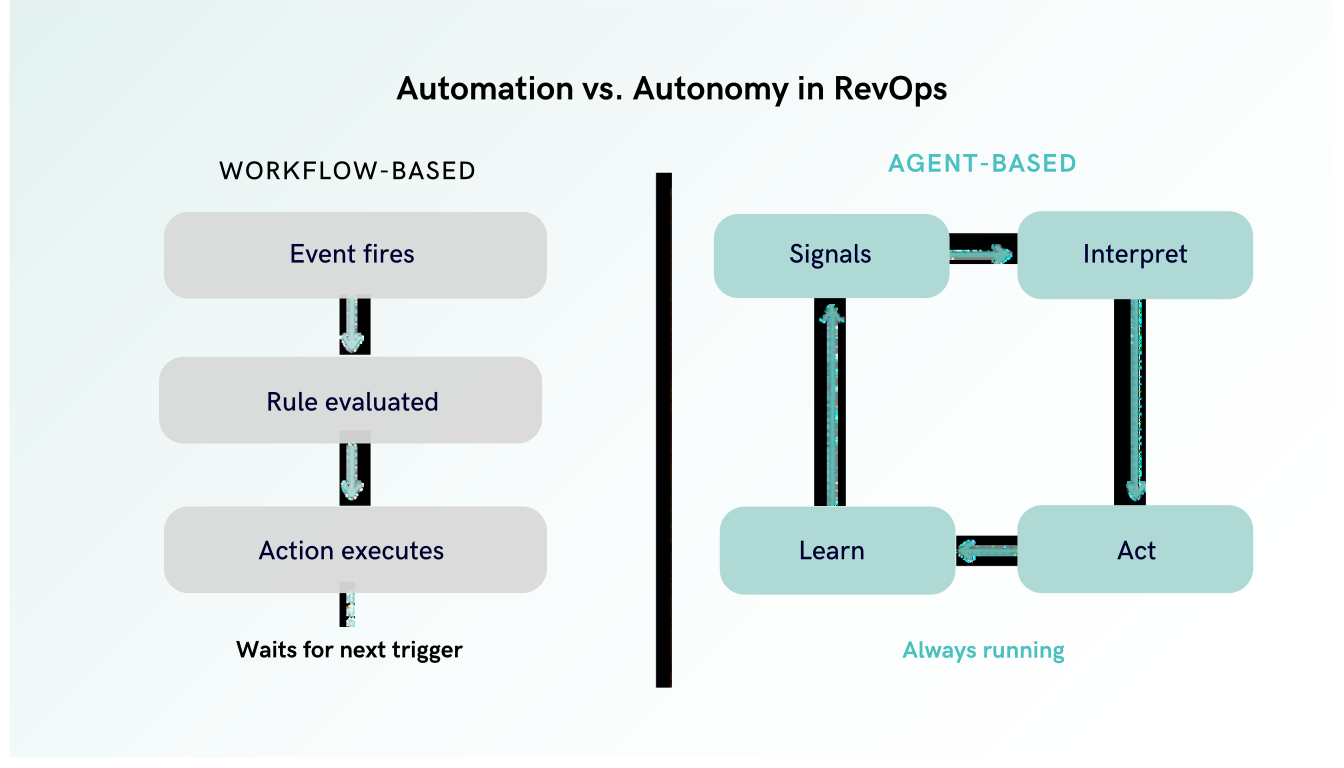
Autonomy is not just automation with better tooling. It is a different operating model.
An autonomous RevOps system does three things:
- Continuously ingests and interprets signals from structured and unstructured sources
- Makes context-aware decisions without predefined rules
- Executes actions across systems while learning from outcomes
This requires a shift from workflows to agents.
Defining Agents in a RevOps Context
An agent is not a chatbot. It is a system that can:
- Perceive: Gather data from multiple sources, including CRM, product usage, external signals, and content
- Reason: Interpret that data in context of goals and constraints
- Act: Execute tasks across systems such as updating records, triggering outreach, or generating content
- Learn: Adjust its behavior based on feedback and results
Instead of encoding every possible scenario upfront, you define objectives and constraints. The agent determines the path.
The Architecture of Agent-Based RevOps
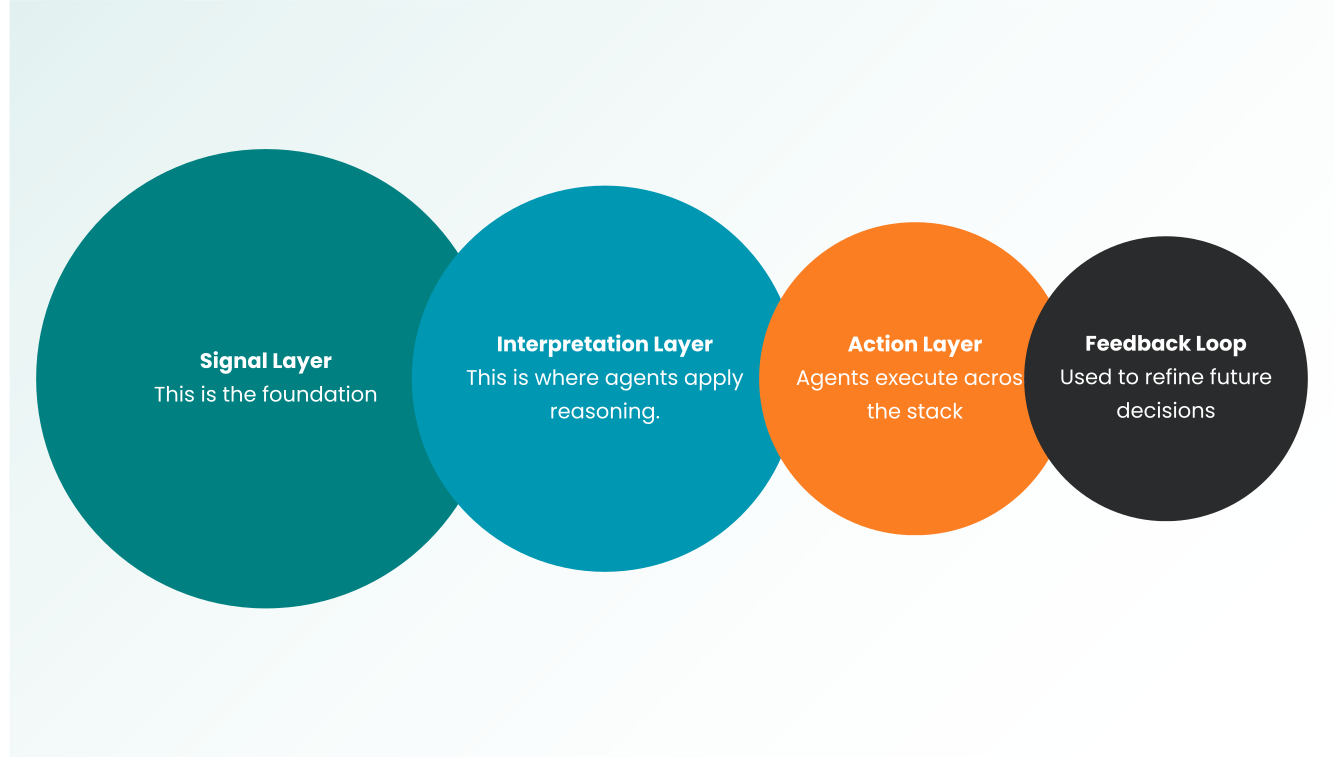
To make this concrete, it helps to break down how an agent-based system is structured.
Signal Layer
This is the foundation. It includes:
- CRM data
- Product usage events
- Website interactions
- Third-party intent data
- Public web data such as job postings, news, and company updates
- Communication data from calls, emails, and meetings
The key difference is that the system does not require all signals to be structured. It can ingest raw text, transcripts, and web content.
Interpretation Layer
This is where agents apply reasoning.
Instead of rules like “if score > 80 then route”, the system evaluates:
- What is the likelihood that this account is in-market
- What is the urgency
- What is the best entry point
- What message would resonate given recent activity
This layer uses models that can synthesize multiple weak signals into a coherent view.
Action Layer
Agents execute across the stack:
- Update CRM fields
- Assign accounts to reps
- Generate personalized outreach
- Trigger campaigns
- Create tasks and alerts
The difference is that actions are not tied to a single trigger. They are the result of continuous evaluation.
Feedback Loop
Every action generates feedback:
- Did the rep engage?
- Did the prospect respond?
- Did the deal progress?
- Did the message resonate?
This feedback is used to refine future decisions.
Real-World Example: Replacing SDR Workflows
Consider a B2B SaaS company with a traditional SDR setup.
The Workflow-Based Model
Leads enter through forms or are sourced from lists. They are scored based on firmographic and behavioral data. Once they cross a threshold, they are routed to SDRs. SDRs follow predefined sequences.
Problems observed:
- High volume of low quality leads
- Delayed response times for high value accounts
- Generic messaging that does not reflect context
- Significant manual effort in research
The Agent-Based Model
Now replace this with an agent-driven system.
The agent continuously monitors a set of target accounts. It pulls in signals such as:
- Recent hiring trends
- Product launches
- Changes in website messaging
- Engagement with content
- Technographic changes
A typical flow looks like this:
- It identifies that a specific account has recently hired a Head of RevOps and is scaling outbound teams.
- The agent infers a likely need for better pipeline generation and measurement.
- It generates a tailored outreach message referencing these signals and suggests a specific angle.
- It assigns the account to the most relevant rep based on expertise and current capacity.
- It creates a task with context, not just a name and email.
- It monitors engagement. If the prospect opens but does not respond, it adjusts the follow-up with a different angle.
This is not a sequence. It is a dynamic interaction.
Outcomes
- Higher response rates due to relevance
- Better allocation of SDR time toward high probability accounts
- Reduced manual research effort
- Faster engagement with in-market accounts
Real-World Example: Pipeline Hygiene and Forecasting
Forecasting is another area where workflows struggle.
The Workflow-Based Model
Deals are updated manually by reps. Forecast categories are assigned based on stage and probability fields. RevOps builds dashboards to track pipeline health.
Issues:
- Inconsistent data entry
- Lagging indicators
- Limited visibility into deal quality
- Forecasts that rely heavily on rep judgment
The Agent-Based Model
An agent monitors deal activity across systems:
- Email exchanges
- Call transcripts
- Meeting frequency
- Stakeholder involvement
- Deal progression patterns
It identifies signals such as:
- Reduced engagement from key stakeholders
- Objections mentioned in calls
- Delays in next steps
The agent updates deal health dynamically. It flags risks before they appear in stage changes.
It can suggest actions to reps:
- Re-engage with a specific stakeholder
- Address a particular objection
- Adjust pricing or packaging
For leadership, forecasts become more grounded in actual activity rather than static probabilities.
Outcomes
- More accurate forecasts
- Earlier identification of at-risk deals
- Actionable insights rather than passive reporting
Why Most Organizations Get This Wrong
There is a tendency to layer AI on top of existing workflows and call it transformation. This usually fails. MIT’s 2025 report found that 95% of enterprise AI initiatives fail, not because the technology is not capable, but because businesses chase flashy projects that never make it out of pilot.
Adding AI to Broken Processes
If the underlying logic is flawed, adding AI does not fix it. It amplifies the problem.
For example, using AI to generate outreach based on poor targeting data results in scaled irrelevance.
Treating Agents as Features
Agents are not features within existing tools. They require orchestration across systems.
Trying to confine them within a single platform limits their effectiveness.
Lack of Clear Objectives
Agents need well-defined goals. Without clear objectives, they either do nothing useful or operate in ways that do not align with business outcomes.
How to Transition from Workflows to Agents
This is not a rip-and-replace exercise. It is a phased transition.
Step 1: Identify High-Friction Areas
Look for areas where workflows are breaking:
- SDR productivity
- Lead routing and prioritization
- Pipeline visibility
- Customer expansion
These are typically the best starting points.
Step 2: Define Objectives, Not Rules
Instead of defining logic, define outcomes.
- Maximize response rate from target accounts
- Improve forecast accuracy
- Increase expansion revenue
Let the agent determine how to achieve these within constraints.
Step 3: Build a Unified Signal Layer
Most organizations have fragmented data.
Invest in consolidating signals from CRM, product, and external sources. The quality of the agent depends on the quality of inputs.
Step 4: Start with Narrow Use Cases
Do not attempt to automate the entire GTM motion at once.
Start with a specific use case such as outbound prioritization or deal risk detection.
Validate impact before expanding.
Step 5: Integrate with Human Workflows
Autonomy does not mean removing humans.
Agents should augment decision making and execution. Reps and operators remain critical, especially for complex interactions.
Step 6: Establish Feedback Mechanisms
Measure outcomes and feed them back into the system.
- Response rates
- Conversion rates
- Deal progression
- Customer satisfaction
This is how the system improves over time.
The Role of RevOps in an Agent-Driven World
This shift changes the role of RevOps.
From System Builders to System Orchestrators
Instead of building workflows, RevOps designs the architecture of agent systems.
- Defining data models
- Selecting signal sources
- Setting objectives and constraints
- Ensuring alignment across teams
From Reporting to Insight Generation
Dashboards become less central. The focus shifts to generating insights and enabling action.
From Maintenance to Optimization
Less time spent fixing broken workflows. More time spent refining models and improving outcomes.
Risks and Considerations
This is not without challenges.
Data Quality
Agents amplify both good and bad data. Poor data leads to poor decisions.
Governance
Autonomous systems need guardrails.
- What actions can they take
- What approvals are required
- How to audit decisions
Change Management
Teams need to trust the system. This requires transparency and gradual adoption.
What This Means for the Future of GTM
The companies that adopt agent-based RevOps systems will operate differently. They will move faster because decisions are made continuously, not in batches. They will be more precise because actions are based on context, not generic rules. They will be more efficient because manual work is reduced. Most importantly, they will be more aligned with how buyers actually behave.
The shift from automation to autonomy is not incremental. It is structural. Workflows were designed for a world where processes were stable and data was limited.
That world no longer exists.
The next generation of RevOps systems will not be defined by how many workflows they have, but by how effectively their agents can understand, decide, and act.
And the organizations that embrace this shift early will not just improve efficiency. They will redefine how revenue is generated.
Frequently Asked Questions
What is the main difference between traditional workflows and agent-based RevOps?
Traditional workflows rely on static, “if-then” logic that becomes fragile as business needs change. In contrast, agent-based systems use reasoning and context to make dynamic decisions without needing predefined rules for every scenario.+3
Why do most AI initiatives fail?
Around 95% of AI initiatives fail because companies try to layer expensive technology on top of broken, manual processes. Using AI to automate flawed logic often just amplifies existing problems rather than fixing them.
How does an autonomous system handle unstructured data?
Unlike workflows that require tidy, structured fields, agents can ingest and interpret raw signals. This includes “unstructured” information like call transcripts, job postings, and website messaging changes to form a more complete picture of a buyer’s intent.
Does moving to an autonomous system mean removing humans from the process?
No. Autonomy is designed to augment human decision-making, not replace it. While agents handle manual data hygiene and research, RevOps professionals shift their focus to orchestrating the system architecture and managing complex high-value interactions.
About the Author:
Karthikeyan Kumaran is a GTM systems leader with 12+ years of experience architecting and scaling revenue engines for B2B SaaS companies by tightly integrating product, marketing, and revenue operations. He leads the shift from static campaigns to adaptive, intelligence-driven growth systems that convert fragmented data and customer signals into predictable, scalable revenue. He has a proven track record of transforming RevOps infrastructure end-to-end, building and mentoring high-performing cross-functional teams, and operationalizing advanced AI and automation workflows to materially improve targeting precision, pipeline quality, and outbound efficiency. Known for combining strategic vision with hands-on execution, he consistently drives measurable impact across acquisition, conversion, and expansion by aligning GTM strategy with real-time market intelligence.

Author Karthikeyan Kumaran
Stay up to date on RevOps trends
Subscribe to receive the latest news and insights directly to your inbox.
Share on:


Related Articles

RevOps
From Founder-Led Selling to a Scalable Revenue Engine: A RevOps Strategy Guide

Chris Hirst
Fri Mar 27, 2026
AI in RevOps Future of RevOps RevOps
How AI is Fundamentally Changing RevOps

Preeti Chadha Doshi
Tue Jul 15, 2025