
From Founder-Led Selling to a Scalable Revenue Engine: A RevOps Strategy Guide

Article Highlights
- Founder-led selling creates a fragile revenue model where growth is capped by one person’s bandwidth, not the business’s potential.
- Revenue Operations (RevOps) aligns sales, marketing, and customer success around three pillars: process, data, and accountability.
- A CRM as the single source of truth is the non-negotiable foundation. If it is not in the system, it does not exist.
- Mature RevOps teams achieve pipeline coverage of 3-5x quota and forecast accuracy within 5-10% of actuals, according to Clari and Salesforce benchmarks.
- Execution discipline, not strategy, is where most companies break down. The system only works when CRM usage is non-negotiable and process is followed consistently.
When the CEO Becomes the Bottleneck
In a lot of growing companies, the CEO becomes the best salesperson by accident, not design. Early wins come from founder relationships, instinct, and hustle, not from a defined process.
Deals live in inboxes, text messages, and memory rather than a structured system. There’s little consistency in how opportunities are qualified, advanced, or forecasted, and success depends heavily on the CEO’s direct involvement.
What Breaks When You Try to Scale
As the business scales, the cracks begin to show.
Pipeline visibility is limited or inaccurate, forecasting becomes guesswork, and new hires struggle without a clear playbook. There’s no standardized process to replicate what works, no reliable data to inform decisions, and no infrastructure to support consistent execution across teams.
What once felt like agility turns into bottlenecks, missed opportunities, and stalled growth.
The solution? A structured Revenue Operations Strategy.
What Is Revenue Operations (RevOps)?
Revenue Operations is the business function that aligns sales, marketing, and customer success teams around shared processes, shared data, and shared metrics. Rather than three teams running separate plays with separate tools, RevOps creates a coordinated revenue engine where every function works from the same system of record and toward the same outcomes.
The goal is not to add bureaucracy. The goal is to make revenue predictable.
The Three Pillars of a RevOps Strategy
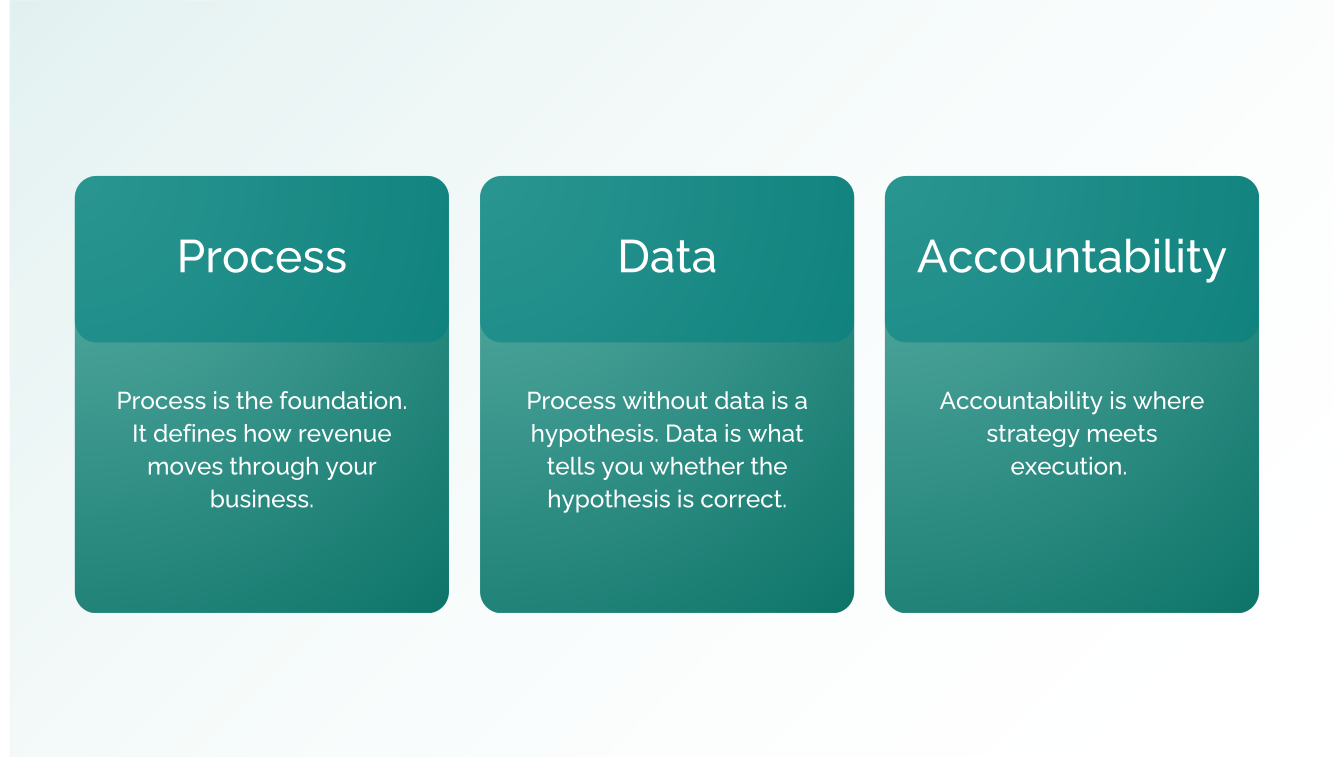
A working RevOps strategy is built on three interconnected pillars: process, data, and accountability. Each one depends on the others.
Pillar 1: Process
Process is the foundation. It defines how revenue moves through your business: how leads are generated, how they are qualified, how opportunities are advanced, and how closed deals are handed off to customer success.
Without documented stage definitions and clear exit criteria, every rep works differently. That makes it impossible to coach, forecast, or replicate what works. Effective sales pipeline management starts with agreement on what each stage actually means and what it takes to move forward.
A strong process design also includes a clearly defined Ideal Customer Profile, or ICP. An ICP is a description of the company type and contact role most likely to buy, stay, and grow with you. Your ICP informs how leads are scored, which opportunities sales should prioritize, and how marketing should allocate budget.
Aligning this process across marketing, sales, and customer success creates a full lifecycle view of revenue, from first touch to renewal.
Pillar 2: Data
Process without data is a hypothesis. Data is what tells you whether the hypothesis is correct.
The foundation here is a CRM as the single source of truth for all revenue activity. The operating principle is simple: if it is not in the system, it does not exist. Every contact, opportunity, activity, stage change, and note lives in one place. No side spreadsheets or parallel trackers.
From there, you establish consistent KPIs across the revenue team:
– Pipeline coverage: Aim for 3-5x quota. The right ratio for your team is derived from your actual win rate. A 25% win rate means you need 4x pipeline to reliably hit quota.
– Stage-to-stage conversion rates: Where deals die tells you exactly where to focus coaching and process improvement.
– Sales cycle length: How long deals take to close, by segment and by source.
– Forecast accuracy: According to Clari’s revenue benchmarks, high-performing teams achieve forecast accuracy within 5-10% of actuals.
Pillar 3: Accountability
Accountability is where strategy meets execution. It means establishing a weekly operating cadence with pipeline reviews, KPI tracking, and defined next steps for every open opportunity. Sales leaders coach to the process, not just to the outcome. Stale deals get flagged. Pushed close dates come with a documented reason. Silent slides are not acceptable.
Accountability also means ownership is explicit. Marketing owns lead generation and MQL quality. Sales development owns pipeline creation. Account executives own opportunity progression. Customer success owns retention and expansion.
Each team has defined handoffs, and each handoff has a service level agreement, so nothing falls through the gaps.
The Technology That Makes It Work
Strategy without the right tools stays on paper.
The stack below is a proven starting point for growth-stage companies making the move from founder-led selling to scalable RevOps.
| Category | Tool | What It Does |
|---|---|---|
| CRM | HubSpot | Single source of truth for all contacts, accounts, opportunities, and pipeline data. The most common CRM choice for growth-stage B2B companies under 100 people. |
| Marketing Automation | HubSpot Marketing Hub | Lead capture, email nurture, campaign tracking, and attribution. Keeps marketing and sales data in the same system, which eliminates the most common source of handoff friction. |
| Sales Engagement and Research | Apollo.io | B2B contact database combined with outbound sequencing. Helps sales reps find qualified prospects that match your ICP and engage them through structured, trackable outreach. |
| Data and Reporting | Native HubSpot Dashboards | Pipeline visibility, conversion tracking, and KPI reporting without requiring a separate BI tool at this stage. Gives leadership real-time deal status and forecast data. |
| Integration | Zapier | No-code automation that connects your tools and triggers actions across systems. Acts as a lightweight orchestration layer: when a deal changes stage in HubSpot, Zapier can notify the right person in Slack, update a field, or kick off a follow-up task automatically. |
| Collaboration | Slack | Internal communication across the revenue team. Used to surface deal alerts, pipeline notifications, and cross-functional handoff signals in real time. |
A note on the orchestration layer: as your stack grows, you will need a way to connect systems, unify data, and surface signals in real time, such as deal risk, pipeline gaps, or accounts showing expansion intent.
The principle remains the same: technology should reduce friction, not add complexity.
Execution: Where Most Companies Break Down
Scaling Beyond Manual Management
As the organization scales, execution shifts from manual management to process-driven automation and accountability across teams. Marketing, sales, and customer success must operate from shared metrics and a unified view of the customer, with clearly defined handoffs and SLAs.
Technology should reduce friction, not add complexity by automating routine tasks, surfacing insights, and enabling proactive decision-making. This is where orchestration becomes critical; instead of chasing reports, teams act on real-time signals like deal risk, pipeline gaps, and customer expansion opportunities.
Ultimately, strong execution means the business no longer relies on heroics, but it runs on consistency, visibility, and a system that drives predictable revenue growth.
What Results Look Like When RevOps Works
Over time, these operational improvements translate directly into revenue and cost outcomes.
- Win rates increase as teams focus on qualified opportunities
- Customer acquisition costs decrease due to better targeting and alignment
- Revenue per rep rises with more efficient execution.
Organizations often see a lift in pipeline conversion, faster sales cycles, and a reduction in administrative effort.
Beyond the numbers, the biggest outcome is predictability where revenue becomes a managed system rather than a series of isolated wins.
Frequently Asked Questions
About the Author:
With over 20 years of experience, Chris Hirst specializes in driving innovative supply chain solutions and operational excellence at CSCS LLC. He is passionate about leveraging AI-powered tools and RevOps strategies to streamline legacy systems, enhance real-time decision-making, and foster collaborative growth.

Author Chris Hirst
Stay up to date on RevOps trends
Subscribe to receive the latest news and insights directly to your inbox.
Share on:


Related Articles
Lead Routing RevOps
Lead Routing Best Practices: How to Ensure Faster Response Times
Fri May 23, 2025

Fractional Services Sales Ops
Bind Marketing and Sales Teams Together in Four Steps

Quimby Melton
Fri Apr 05, 2024