
Reimagining RevOps with AI at the Core
Article Highlights
- Revenue is a lifecycle, not a departmental output, and RevOps is the operating system built to manage it end to end.
- Functional silos in marketing, sales, and customer success cost B2B companies 10–38% of revenue annually due to misalignment and broken handoffs.
- AI adoption in business jumped from 33% to 71% between 2023 and 2024 (McKinsey), yet fewer than 10% of RevOps teams report meaningful ROI, because most are still using AI for isolated tasks rather than embedding it into the full revenue workflow.
- When AI is placed at the core of RevOps (not bolted on), it eliminates silos, creates a shared data language, and shifts the revenue function from reactive reporting to predictive action.
Revenue Is a Lifecycle, Not a Department Output
Ask most business leaders what drives their company forward, and the answer will inevitably circle back to one word: revenue. But for decades, that word was treated as an output, something that happened at the end of a sales cycle, celebrated in a quarterly report, and handed off to finance. The truth is more complex, and frankly, more interesting.
Revenue is a lifecycle. It begins the moment a potential customer first encounters your brand, and it does not end when a deal is closed. It continues through onboarding, support, renewal, and expansion. Every touchpoint, every handoff, every piece of data exchanged along that journey either adds to or erodes the revenue potential of a relationship. Understanding this is the foundation of what we now call Revenue Operations.
Revenue Operations (RevOps) is the unified organizational function that aligns marketing, sales, and customer success operations around shared processes, data, and metrics to drive predictable, efficient revenue growth across the full customer lifecycle. It serves as the connective infrastructure linking every revenue-generating team in a business.
RevOps, at its core, is the operating system of a modern business. It encompasses every process, every system, and every person involved in and responsible for generating revenue. That is a wide net, and intentionally so.
The World Before RevOps: Functional Silos and Broken Handoffs
To appreciate where RevOps has brought us, you need to understand where we came from.
For most of the 20th century, and well into the early 2000s, the revenue-generating functions of a business operated in almost complete isolation from one another. Marketing lived in one world. Sales lived in another. Customer success, when it existed at all, was largely an afterthought, tucked away in a support queue somewhere.
Each function had its own tools, its own data, its own language, and critically, its own definition of success. Marketing was judged on the volume of leads generated; the more, the better, regardless of quality. Sales teams were measured purely on closed revenue, with little accountability for whether the deals they closed were the right fit for the business. Customer service handled post-sale issues but was almost entirely disconnected from revenue goals, seen as a cost center rather than a growth lever.
The consequences were predictable. Leads generated by marketing would be handed off to sales teams who didn’t trust them. Customers who churned were rarely traced back to the point of origin. And the data was fragmented across spreadsheets, CRMs, and email threads, interpreted differently by every
function that touched it.
The customer experienced this dysfunction acutely. They would have one conversation with a sales rep, only to find themselves re-explaining everything to a support agent after the deal closed. The left hand did not know what the right hand was doing, and customers bore the cost.
What RevOps Actually Covers
Before going further, it is worth being precise about what RevOps actually means in practice, because it is broader than most people initially assume.
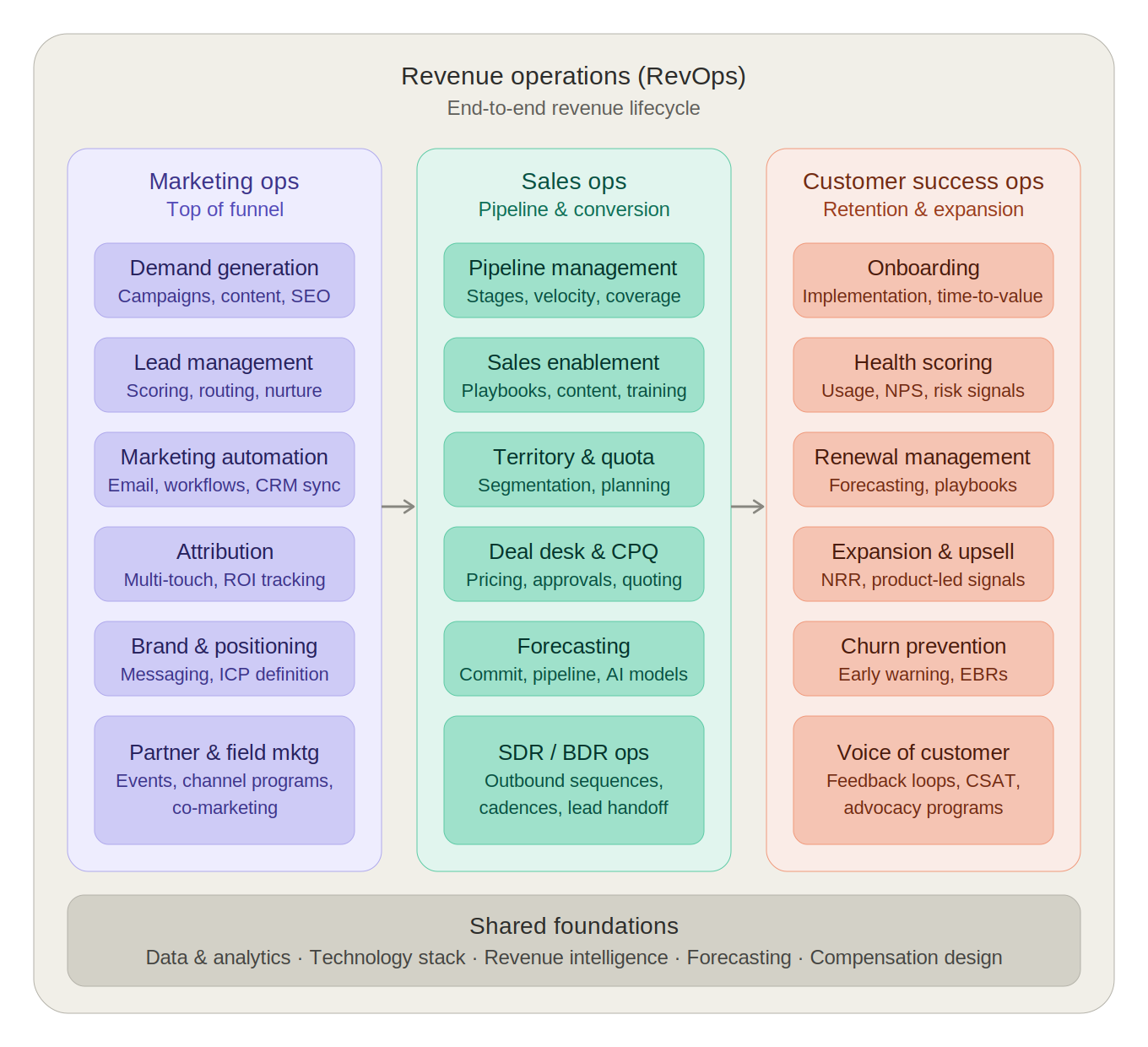
At its fullest expression, RevOps spans three interconnected pillars: Marketing Operations, Sales Operations, and Customer Success Operations. Each pillar contains its own set of functions, but they all serve a single shared objective: predictable, efficient revenue growth across the full customer lifecycle.
Beneath all three pillars sits a shared foundation, data and analytics, the technology stack, revenue intelligence, forecasting, and compensation design. This is what makes RevOps more than just three departments reporting to the same leader. It is the common infrastructure that allows every function to operate from the same truth.
The Late 2010s: The Awakening
By the late 2010s, the cracks in the siloed model had grown too wide to paper over. The explosion of SaaS business models, subscription economics, and customer lifetime value as a primary metric forced leadership teams to confront an uncomfortable truth: the functional silos that had worked well enough in a transactional economy were actively destroying value in a relationship-driven one.
The concept of Revenue Operations emerged as the organizational answer to this problem. The insight was simple but radical: if revenue is the shared outcome, then the functions that generate it should share the same processes, the same data, and the same metrics. RevOps would become the connective tissue linking marketing, sales, and customer success into a single, coherent engine.
Companies that made the shift quickly began to see the benefits. With end-to-end visibility into the customer lifecycle, from first marketing touch to renewal conversation, teams could identify where deals were stalling, where leads were leaking, and where post-sale experience was undermining retention. The customer journey, once invisible to any single function, became a shared map that every team could navigate. Research shows that companies with strong sales and marketing alignment achieve 20% higher annual growth, compared to a 4% decline for misaligned organizations.
Perhaps most powerfully, a unified RevOps function enabled a shared north star. When marketing, sales, and customer success are all measured against the same revenue outcomes, the internal politics of whose fault it is give way to a collective focus on how to fix it. That shift in accountability changes everything about how teams collaborate and make decisions.
- Gartner predicted that 75% of the highest-growth companies would deploy a RevOps model by 2026.
- The RevOps software market is projected to grow from $3.45B in 2024 to $10.25B by 2033, a CAGR of 13.5%.
- Ccompanies with formal RevOps functions report 36% higher revenue growth than those without.
RevOps is no longer an experiment. It is the architecture of modern business. And now, it is about to be fundamentally reimagined again.
The AI Renaissance: RevOps Gets Its Second Act
If the late 2010s were about recognizing that siloed functions needed to be connected, the mid-2020s are about recognizing that human-managed connections have limits. Data volumes have exploded. Customer journeys have become more complex. The speed at which market conditions shift has left even well-designed RevOps functions scrambling to keep pace.
Enter AI: not as a buzzword layered on top of existing systems, but as the connective tissue that RevOps has always needed but never had.
The real opportunity is connecting every part of the revenue engine, from CRM hygiene and prospect research to account handoffs and call coaching, within a single intelligent workflow. This is what AI makes possible in a way that manual processes and static dashboards simply cannot.
Consider the data problem alone. Deal updates sit in Slack, customer context hides in email threads, and product usage data stays siloed in separate systems. Operations teams spend hours each week pulling reports, cleaning spreadsheets, and reminding reps to update fields, time that could be spent improving processes or strategies. AI does not just automate that work; it eliminates the conditions that created it in the first place.
- The use of generative AI across business functions jumped from 33% in 2023 to 71% in 2024.
- 75% of companies using AI-driven sales forecasting report a significant increase in forecast accuracy, with a 15-20% reduction in forecast errors vs. traditional methods.
- For every dollar spent on generative AI, adopters are seeing returns of $3.70.
The teams that will win the next decade of revenue growth are the ones who figure this out first. BCG framed it plainly in their 2025 report: AI was made for RevOps, and the path forward runs from prediction to execution.
What AI Actually Changes About RevOps
When AI is placed at the core of Revenue Operations, not bolted on as a tool, but embedded as the operating layer, three things happen that were not possible before.
First, the silos do not just get bridged, they become irrelevant. AI can autonomously connect the dots between functions, reading signals across marketing, sales, and customer success simultaneously. A drop in engagement from a high-value account can trigger a flag in the CRM, alert the customer success team, and adjust the renewal forecast, without a single human touching it. The handoff, historically the most failure-prone moment in the revenue lifecycle, becomes an automated, data-rich event rather than a manual, context-losing one. Gong, for example, tracks 300-plus unique signals to predict deal outcomes with 20% more precision than algorithms based on CRM data alone. That is the kind of intelligence that simply cannot be replicated through manual processes.
Second, the data finally speaks a common language. One of the deepest problems in traditional RevOps is that different functions not only have different data, they have different interpretations of the same data. What counts as a qualified lead to marketing is often very different from what sales considers closeable. AI, when trained on the full revenue dataset, can translate across these interpretations, surface what is actually predictive, and create a single source of truth that every function trusts and acts on. True transformation requires AI that understands your business, connects your data, and delivers auditable results in real time. For teams serious about activating AI across revenue operations, data unification is the non-negotiable first step.
Third, the revenue function moves from reactive to predictive. Traditional RevOps, even well-executed, is largely a reporting function, it tells you what happened. AI-powered RevOps tells you what is about to happen and, increasingly, takes action to influence the outcome. The science behind sales forecasting has fundamentally shifted: teams using AI-driven models see forecast errors drop by 15-20% compared to traditional methods, which means fewer missed quarters, fewer surprise churns, and more reliable board-level conversations.
The economics are compelling as well. For every dollar spent on generative AI, adopters are seeing returns of $3.70, with financial services companies reporting returns as high as 4.2x.
How to Start: Moving AI from Bolt-On to Built-In
The gap between AI experimentation and AI transformation comes down to where you plug it in. Most teams start with point solutions, an AI tool for account research here, an automated email sequence there. Those are fine starting points, but they are not a transformation.
Transformation looks like this: AI embedded into the workflows that govern how leads move through the funnel, how accounts get scored and routed, how forecasts get built, and how customer health gets monitored. It means your CRM data is continuously audited and enriched by AI rather than periodically cleaned by hand. It means your lead scoring models update dynamically as behavior signals come in, not quarterly when someone gets around to it. It means handoffs between marketing, sales, and customer success carry full context automatically, so the customer never has to repeat themselves.
For teams evaluating where to start, the highest-leverage entry point is usually wherever your most expensive data loss is occurring: the marketing-to-sales handoff, the sales-to-success transition, or the renewal forecasting process. Pick the one that costs the most when it breaks, and build your AI infrastructure there first.
If your team is ready to move beyond experimentation, GTM AI enablement frameworks offer a structured path from strategy to execution.
The Road Ahead
We are at the beginning of a second renaissance in Revenue Operations. The first wave gave us the framework, the recognition that revenue is a lifecycle and that every function contributing to it must be aligned. The second wave, powered by AI, gives us the infrastructure to actually live that framework at scale and speed.
The companies that treat AI as a point solution, a smarter chatbot here, an automated email sequence there, will see marginal gains. The companies that embed AI at the core of their RevOps architecture, as the layer that connects systems, translates data, and autonomously manages handoffs, will see something different: a revenue engine that learns, adapts, and compounds over time.
The question for every revenue leader is no longer whether to integrate AI into RevOps. It is whether you are willing to go deep enough for it to actually change how your business runs.
Revenue has always been a lifecycle. Now, for the first time, we have the tools to manage it like one.
Frequently Asked Questions
How is AI changing Revenue Operations?
AI is shifting RevOps from a reactive reporting function to a predictive, autonomous one. When embedded at the core, rather than added as a standalone tool, AI can automate handoffs between teams, unify data across systems, flag at-risk accounts in real time, and improve forecast accuracy by 15-20%. The key shift is from using AI for isolated tasks to embedding it into end-to-end revenue workflows.
Why do most RevOps teams fail to see ROI from AI?
According to Default’s 2025 State of AI in RevOps report (based on 300 teams), fewer than 10% of RevOps teams report meaningful ROI from AI. The primary reason is deployment pattern: most teams use AI for low-leverage, standalone tasks like account research, rather than integrating it into the workflows that govern lead routing, forecasting, handoffs, and customer health monitoring.
What is the ROI of AI investment in RevOps?
According to a 2024 IDC study commissioned by Microsoft, organizations are seeing an average return of $3.70 for every dollar invested in generative AI, with financial services companies reporting returns as high as 4.2x. The ROI is highest when AI is embedded into core revenue workflows rather than used as a supplementary research or content tool.
What percentage of companies have adopted the RevOps model?
According to the Revenue Operations Alliance, 79% of organizations now have a formal RevOps function. Gartner’s 2021 prediction that 75% of the highest-growth companies would deploy RevOps by 2025 has largely proven accurate, confirming RevOps as the standard architecture for modern revenue teams.
What are the three pillars of RevOps?
The three core pillars of Revenue Operations are Marketing Operations (pipeline generation, campaign management, lead scoring), Sales Operations (forecasting, territory design, pipeline management, compensation planning), and Customer Success Operations (onboarding, health tracking, upsell motions, renewal management). All three sit on a shared foundation of data infrastructure, technology stack, and revenue intelligence.
How do I start embedding AI into my RevOps function?
Start by identifying your most expensive point of data loss: the marketing-to-sales handoff, the sales-to-success transition, or your renewal forecasting process. Build AI infrastructure at that failure point first — whether that is automated CRM enrichment, dynamic lead scoring, or AI-assisted handoff documentation. Expand from there into adjacent workflows once the first use case is producing measurable results.
About the Author: Archana Vadya has spent twenty years building the infrastructure that partner ecosystems and revenue operations run on, including fourteen years at Oracle in channel incentives and PRM, CLM and CPQ work at Conga across a 500+ enterprise customer portfolio, and digital backbone modernization at VMware for a $1.1B services segment. She is the founder of PartneRite, where she has shipped production LLM agents for partner matching, recruitment, and quote orchestration. Her work was recognized in the 2025 Canalys/Omdia Channels Ecosystem Landscape.

Author Archana Vadya
Stay up to date on RevOps trends
Subscribe to receive the latest news and insights directly to your inbox.
Share on:


Related Articles
AI in RevOps RevOps
From Automation to Autonomy: Replacing Workflows with Agent-Based RevOps Systems

Karthikeyan Kumaran
Mon Apr 06, 2026
AI in RevOps RevOps
AI Tool Fatigue: What It Means for Your Team and How RevOps Can Fix It
Mon Apr 20, 2026